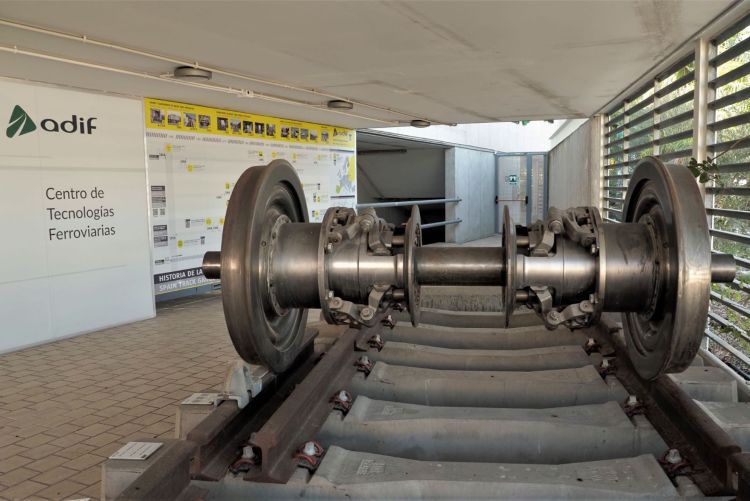
The installation will employ Variable Gauge Freight Axis (VAFM) technology, a solution developed over the last decade as part of Adif’s ongoing R&D activities.
The construction contract, valued at €2.28 million, covers the gauge changer itself, track assembly, overhead line modifications, drainage network improvements, sleeper and rail replacement, as well as mechanical adjustments to the overhead contact line.
Currently, Spain’s rail network uses a wider gauge (1,668 mm) compared to the standard European gauge (1,435 mm). While passenger trains already navigate this gauge difference through established axle-changing systems, freight transport continues to face operational complications due to heavier axle loads and standardized wagon types. Freight operators typically resort to axle swaps or load transfers when transitioning between gauges, incurring higher operational costs and extending journey times.
To address this issue, Adif has been developing and testing automatic gauge-changing technologies for freight transport. The VAFM system includes specially engineered movable axles designed for common freight wagon wheel diameters (920 mm and 760 mm). This technology aims to allow freight wagons to transition seamlessly between different gauge infrastructures without unloading cargo.
The gauge changer at Irun will serve as a practical site for commercial-scale simulations to validate operational readiness. Previously, extensive testing was performed at a dedicated facility in Córdoba, under the MERCAVE innovation project, financed partly through Spain’s Public Procurement of Innovation program. Modular gauge-changing platforms were evaluated there, and further track tests are ongoing across the Córdoba-Málaga conventional line and the Córdoba-Antequera-Granada High-Speed Line.
To date, these axle systems and gauge-changing mechanisms have collectively completed approximately 250,000 kilometers of testing, with an additional 2,000 kilometers of operational trials scheduled. The goal of this extensive testing phase is to achieve full compliance with European Interoperability Standards (ETI).
Funding for this initiative is partially provided by the European Union’s NextGeneration EU programme through Spain’s Recovery, Transformation and Resilience Plan.