The initiative is targeted at cutting journey times on numerous cross-border routes, supported by planned infrastructure investments and regulatory adjustments affecting rail operators, infrastructure managers and Member States.
A plan built on TEN-T
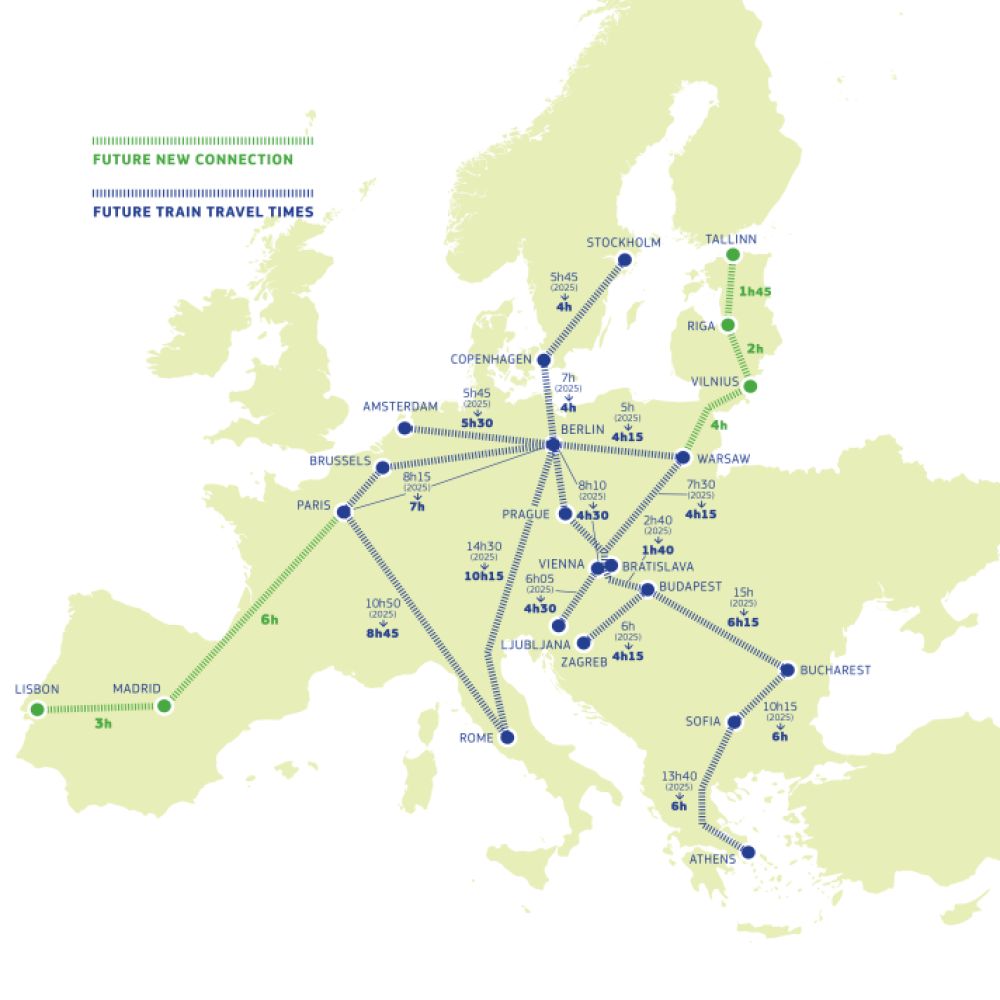
The plan, built on the TEN-T regulation updated in 2024, proposes a network that connects all EU capitals and major urban centres with rail lines designed for speeds above 200 km/h and in some corridors, exceeding 250 km/h where viable. Key examples include the Berlin–Copenhagen route, targeted to be shortened from seven hours to four by 2030, and the Sofia–Athens connection, expected to operate in under six hours by 2035.
Binding corridor implementation decisions by 2027
To ensure delivery by 2040, the Commission intends to set binding corridor implementation decisions by 2027. These decisions will define timelines for the removal of infrastructure bottlenecks and designate sections to be built for very high-speed operation. The construction and upgrade projects are being aligned with resilience and climate-neutrality standards. Environmental impacts, lifecycle emissions, and climate adaptation measures are to be integrated into future rail infrastructure planning.
Full network expansion at almost EUR 550 billion
A dedicated EU financing strategy is expected to be launched by the end of 2025. The Commission estimates the cost of finalising the TEN-T high-speed network at EUR 345 billion, with full network expansion beyond TEN-T costing up to EUR 546 billion. According to external assessments, the societal return of the full build-out could exceed EUR 750 billion. The funding framework includes EU grants, national co-financing, and private investment, with a focus on new financial tools and public-private models like the Regulated Asset Base (RAB) or leasing schemes.
Second-hand market for rolling stock availability
Rolling stock availability is addressed through measures to establish a second-hand market and ban the scrapping of usable high-speed trains. The Commission also intends to revise driver certification rules in 2026, aiming to simplify cross-border crew operations. This revision will be accompanied by the adoption of a new ERTMS deployment plan and harmonised standards for high-speed trainsets.
Entry of new operators
To improve market conditions, the plan tackles barriers to entry for new operators. The Commission will propose changes in 2026 to enable better access to ticketing systems and strengthen passenger rights on journeys involving multiple operators. Track access charges and service facility access are also under review. Infrastructure managers will be required to coordinate capacity offers on long-distance cross-border routes, and a scoreboard will track the implementation of the plan from 2026 onwards.
ERTMS and uniform signalling system on high-speed lines
Operational upgrades are also part of the plan. A shift toward standardisation and digital automation is expected, with an emphasis on rolling out ERTMS as the uniform signalling system across all high-speed lines. This is intended to reduce technical fragmentation and shorten approval timelines for new trainsets.
Military mobility also a factor
The Commission's proposal includes setting up stakeholder roundtables on specific cross-border routes and monitoring progress through newly established governance mechanisms. Military mobility is also factored into the infrastructure agenda, with upgrades expected to benefit dual-use logistics and freight movement alongside civilian passenger traffic.
Significant travel time cuts
Train travel times between major cities are projected to be halved across several corridors. According to estimates in the accompanying maps and data tables, travel from Paris to Madrid could be reduced to 6 hours, while Lisbon–Madrid will drop to 3 hours. Brussels–Berlin is projected at 5h30, and Prague–Vienna at 2h30. Journeys such as Athens–Sofia (currently 13h40) are projected at 6 hours by 2040.
The European Commission intends to finalise its financing strategy in 2026 as part of a broader “High-Speed Rail Deal” initiative with Member States and investors. The rail sector, infrastructure owners, and regional governments are expected to participate in a coordinated effort to deliver the envisioned network within the next 15 years.